MetaData Tab
The MetaData Tab allows you to visualize, filter, and export high-level metadata extracted from your nanopore event database. These metadata attributes include fields such as event duration, maximum blockage, sublevel statistics, conductivity, and more. Plots help explore trends, distributions, and relationships between these features.
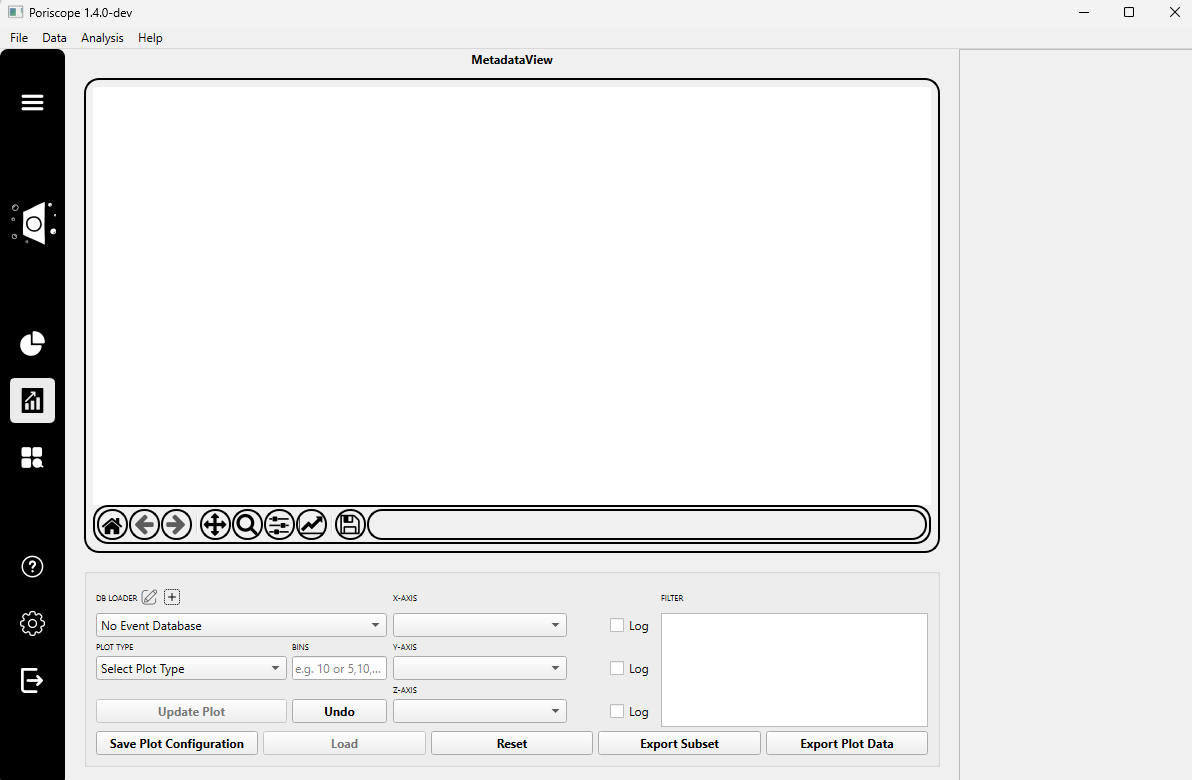
Step 1: Load Metadata Database
Click the ➕ Load Database button to import a fitted events database.
A plugin dialog (e.g.,
SQLiteDBLoader) will appear. In this dialog:Enter a custom Name for the loader instance (e.g.,
SQLiteDBLoader_1).Click Select Input File and choose a valid SQLite .db file previously generated by the Commit function.
Note
Only databases that contain fitted events metadata are compatible with the MetaData Tab.
Step 2: Choose Plot Type and Configure Axes
From the Plot Type dropdown, select the type of visualization you want to generate. Options include:
Histogram / Normalized Histogram
Categorical Histogram
Kernel Density Plot
Capture Rate
Heatmap
Scatterplot / 3D Scatterplot
Raw Event Overlay / Filtered Event Overlay
Raw All Points Histogram / Filtered All Points Histogram, and the normalized form of each
Note
A Categorical Histogram is for a column holding names rather than numbers.
Its bars are ordered by count, tallest on the left; rows where the column is
empty are counted together under null. When several subsets are overlaid the
order is taken from their combined totals, so they share one axis.
Define the number of bins for your plot:
Use a single number for 1D plots (e.g.,
50).Use two comma-separated values for 2D plots (e.g.,
50,50for a heatmap).
Note
Overlaid 1-D datasets share one set of plot limits, so they can be compared, and those limits describe the filtered, log-scaled values that are actually drawn rather than the raw column. A log-scaled Density plot therefore bins differently than it did before 2.0.0.
A plot that cannot be built is reported on the status panel instead of failing: a column that is empty for the selected subset, a capture rate with too few events — which says how few — a heatmap over more than one channel, and an All Points Histogram or Event Overlay whose events cannot be loaded. A Density plot that comes back with nothing to draw leaves the previous plot in place rather than clearing the figure.
Choose the X-axis and (if applicable) Y-axis and Z-axis attributes. These correspond to metadata columns in your database such as:
start_time,duration,event_idbaseline_current,max_blockage,sublevel_stdevvoltage,conductivity, and many more
(Optional) Tick the Log checkbox beside an axis to apply logarithmic scaling to it.
Note
The axis attribute menus are dynamically populated based on the metadata fields present in the loaded SQLite database.
If you want to inspect the structure of your database manually, you can use a SQLite visualizer such as:
Step 3: Apply Filters
You may apply filters to visualize only a subset of events or sublevels.
Click the ➕ next to FILTER to open the Create Subset Filter dialog. Give the subset a name, choose Assisted SQL or Raw SQL, and enter the filter. In Assisted SQL you write only the condition:
duration > 200max_blockage < 600 and num_sublevels >= 3voltage = -200 or sublevel_stdev > 5
Comparison operators are
=!=>>=<<=, joined withandandor.Select one or more filters in the FILTER dropdown to plot them. The icons beside it edit and delete a filter, and Save Filter / Load Filter write and read them as a file.
Warning
A filter naming a column that does not exist is refused with a message on the status panel. Raw SQL filters can be saved and loaded but cannot be selected for a plot. See Filtering and Querying for the full syntax.
Step 4: Generate and Export
Once plot settings and filters are configured, click Update Plot to visualize.
You can then:
Save Plot Configuration: Save the sequence of plots you have made as a JSON file.
Undo: Revert to the previous state.
Load Plot Configuration: Replay a previously saved sequence of plots.
Reset: Return to default settings.
Export Subset - CSV: Save the currently filtered data to CSV for external analysis.
Export Plot Data: Save the data behind the current plot.
Tip
Use “Export Subset” to isolate and save only the events that meet your filtering criteria. This is ideal for downstream machine learning or further statistical analysis.
Step 5: Inspect Individual Events
Beside the plot controls is a Plot Events button with an arrow on either side and a RAW checkbox. It draws the events themselves rather than a summary of them.
Use Scope to select exactly one experiment and one channel. Events are numbered within a channel, so a wider scope is refused with a message rather than guessed at.
Select at most one subset filter. Raw SQL filters cannot be used here; the events plotted are those of the filtered set.
Enter the EVENT INDEX to start from and # EVENTS TO PLOT.
Click Plot Events. The starting index snaps forward to the next event present in the filtered set, wrapping around to the first, and the field updates to show where it landed.
Use the ◀ and ▶ arrows to step through the filtered set.
Check RAW to overlay the unfiltered signal alongside the filtered and fitted traces.
Note
Every refusal is reported on the status panel: more than one experiment or channel in scope, more than one filter selected, a filtered set with no events in it, an experiment the database does not recognise, and a request that asks for no events at all. A plot that cannot be built names what it was plotting and the event ids it was asked for.